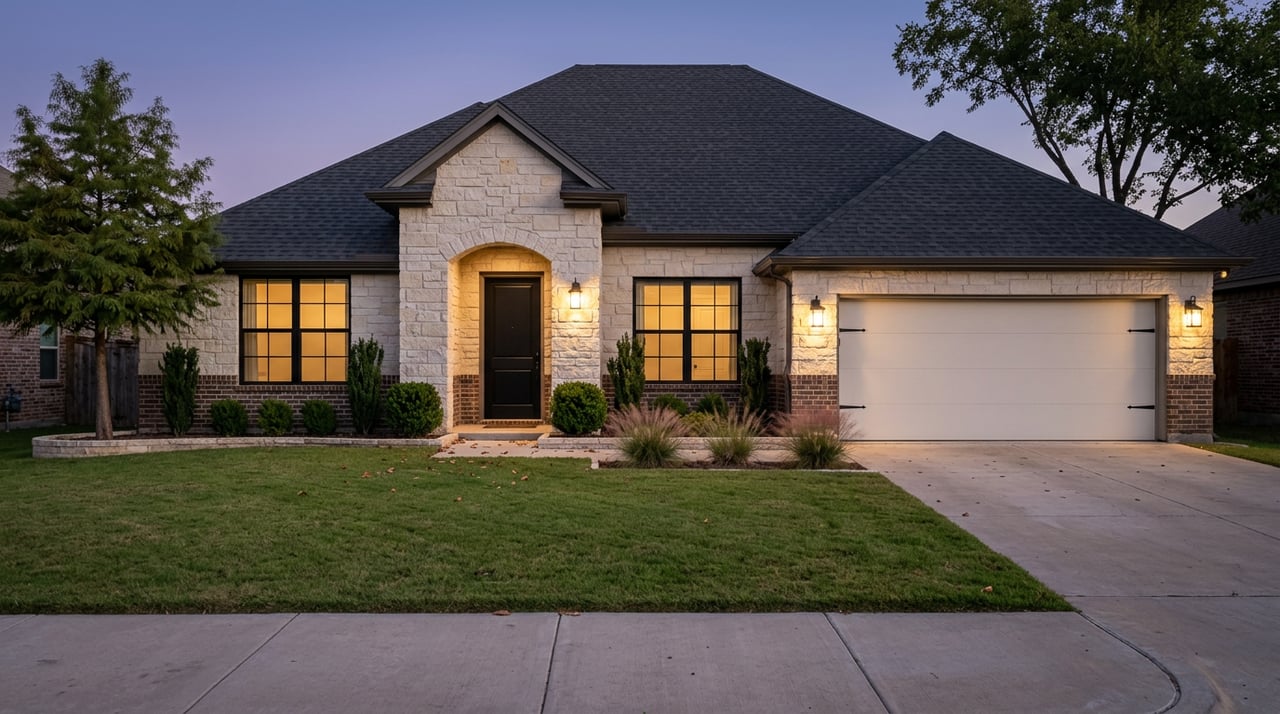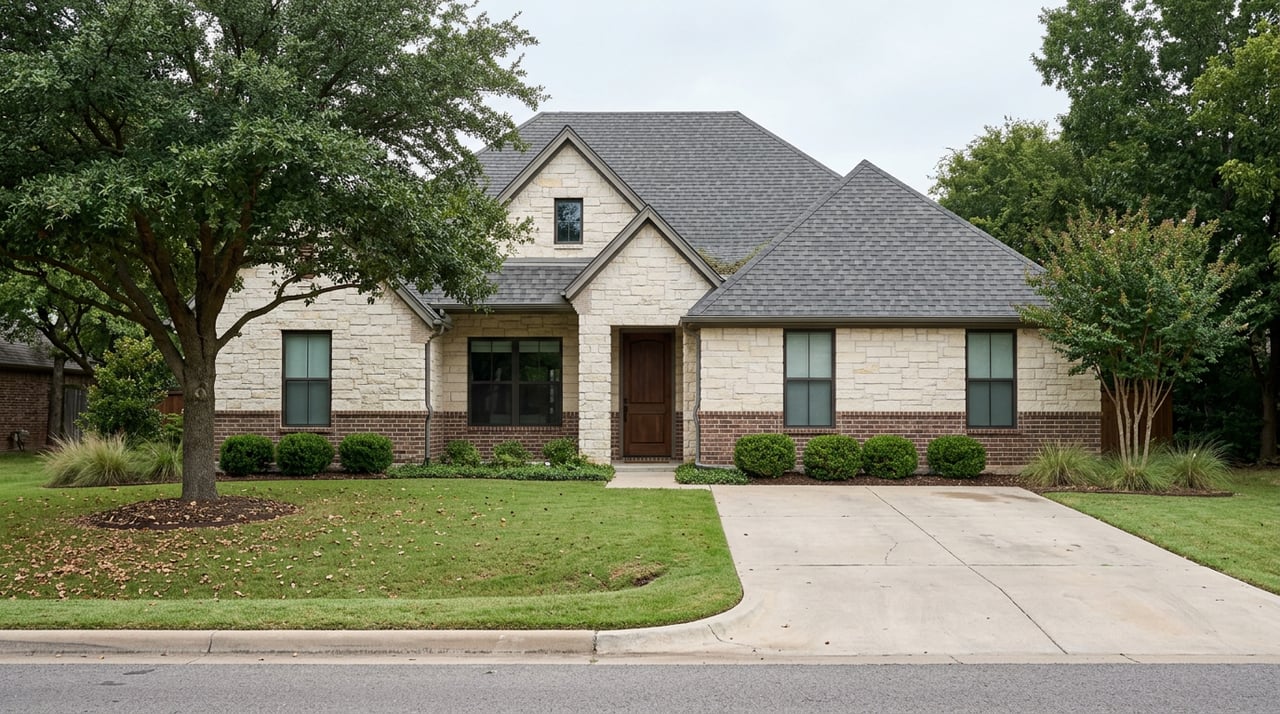
If you live near the entrance to Pebble Creek, you already know about the sign. It marks a one-block cul-de-sac just off the main parkway, and it disappears more often than any other street sign in College Station. The name on it is "12th Man," lowercase m, and the lowercase is deliberate. According to longtime College Station builder Glenn Thomas, who lives on that street with his wife Jo Ann, the missing capital letter was someone's attempt to make the sign less tempting to Aggie fans hunting for a souvenir. It has not worked. The sign still walks off with some regularity, which tells you something true about this neighborhood before you ever set foot on a fairway: the street names here are not filler. People care about them.
That is worth sitting with, because once you start paying attention to what the streets are actually called in Pebble Creek, a pattern shows up. And once you understand where that pattern breaks, you understand something about how this entire neighborhood came to exist.
A map written in golf courses
Drive through Pebble Creek and you are, in effect, touring a list of the world's most famous golf courses without ever leaving south College Station. Augusta Circle. Spyglass Court. St. Andrews Drive. These are not generic names picked for their pleasant sound. They are direct references to Augusta National, Pebble Beach's Spyglass Hill, and the Old Course at St. Andrews in Scotland, the courses that most golfers spend a lifetime hoping to play once. The naming convention runs through nearly every street in the development, which makes sense once you remember what Pebble Creek was built around. This is College Station's only true country club and golf community, anchored by a course that architect Ken Dye designed and that opened for play in the summer of 1992. Dye, based out of Katy, is not related to the more famous course designer Pete Dye, a distinction longtime residents sometimes bring up, but his work here was serious enough that the layout has been recognized more than once as the best golf course in the Brazos Valley.
So the street grid is a kind of tribute. Whoever platted this subdivision wanted every drive home to pass a small reminder of the game the whole place was organized around.
The four streets that don't fit
Here is where the pattern gets interesting, because it is not perfect. Four streets break from the golf course naming entirely:
- Birdie Court
- Bogie Court
- Slice Court
- Spearman Drive
The first three are golf terms rather than golf courses, the kind of insider joke a developer includes when he assumes the people buying lots will get it immediately. But Spearman Drive is different. It is named for the original owner of the property, the person who held the land before Bill Fitch ever bought it and turned it into a country club community.
That one street name is a small crack in the theme, and it is the crack worth following, because it points to the fact that Pebble Creek was not always destined to become a golf course neighborhood. It was farmland first, owned by someone named Spearman, and it became something else because one man had a very specific vision for what south College Station should look like.
The man behind the map
Bill Fitch bought the land that would become Pebble Creek in 1984. By the time he retired in 1993, he had shaped roughly a third of College Station, and Southwest Parkway, the road that spawned development stretching south from the Texas A&M campus, had been his idea. Fitch was a member of the Texas A&M Class of 1942 and a U.S. Army captain who served in World War II. When he came home he served two terms on the College Station city council, at a time when the town's population was only about 4,000 people. He went on to develop neighborhoods across the city with names like Southwood Valley, Leacrest, The Glade, Ridgefield West, South Knoll, Bee Creek, and Dexter Place, and he donated pieces of his own land for parks, schools, and churches along the way.
The city eventually named him, formally, "Mr. College Station," through a 1995 resolution. The road that runs past Pebble Creek carries his name today as William D. Fitch Parkway, a renaming that happened in 2006. When Fitch died in 1997 at age 75, The Eagle's editorial board wrote plainly about what he had meant to the town, closing with the line that his vision had helped shape College Station into "the wonderful community it has become."
None of that means the Pebble Creek project was smooth. By multiple accounts, Fitch ran into financial difficulty during the development and was ultimately forced into a partnership, described at the time as a joint venture, with Young Brothers Contractors of Waco, led by F.M. Young. By the winter of 1991, only 21 of the initial 57 home sites had sold, and just two houses stood finished, one belonging to Larry and Kathy Flynn and the other to Larry and Glenda Mariott. The golf course would not even open for another year. The country club community you see today, with its manicured streets and its waiting list of buyers, started out as a slow, uncertain build that could easily have stalled.
The people who showed up first
Jim Keblinger still lives in the same house on Muirfield Village that he built in 1992, which makes him something close to the longest-tenured resident of the oldest golf course community in College Station. He and his wife Carol moved from Houston to retire here. Keblinger is Texas A&M Class of '53, an Aggie well before Fitch's own development ever broke ground.
Larry Ringer arrived a little later, and by a stranger path. Ringer, who went on to serve as College Station's mayor, moved to Pebble Creek after a fire damaged his home in one of Fitch's other south College Station neighborhoods. He has said he wanted an excuse to get on the golf course, and for a while he lived on the 15th fairway, close enough that he could tee off after work and play three holes home. Ringer and his wife Jean were friends with Bill and Gail Fitch, the kind of relationship that shows up in a lot of early Brazos Valley development stories, where the people building the neighborhoods and the people buying into them knew each other personally.
That is a different picture of Pebble Creek than the one most people carry around, which tends to start and end at the golf course and the clubhouse. The neighborhood's actual origin story involves a land deal that almost fell apart, a builder who had to bring in outside capital to finish what he started, and a handful of families willing to move in before the course was even finished.
Why the street signs still matter
Next time you pass Augusta Circle or turn onto Spyglass Court, the names carry a little more weight. They are not just borrowed prestige from courses most residents will never play. They are the last visible trace of a specific person's plan for this corner of College Station, a plan that survived a financial scare, a slow first two years, and a golf course that opened a full season after the first families moved in.
And if you happen to drive past that unmarked cul-de-sac near the entrance, the one where the sign keeps disappearing, you now know why people want it enough to take it home. In a neighborhood built almost entirely around a shared reference point, that one street name points somewhere else entirely, back to Kyle Field and the tradition that gives College Station its identity outside of golf.
If you want to see how these streets translate into actual homes and lots, our Pebble Creek neighborhood page has current listings and a closer look at the community today. And if a piece of Brazos Valley history like this makes you curious about what it would take to plant your own roots in a neighborhood with this much of a story behind it, Life On The Brazos is always glad to talk. Reach out any time to schedule a free consultation and home valuation, no obligation attached.